|
About 300 years ago, groups of religious refugees
from the Rhine region of Germany migrated to
southeastern Pennsylvania. These settlers, peasant
farmers, came to take advantage of the religious freedom
being offered by William Penn. They included Amish,
Mennonites, Lutherans and other Reformed groups. These
people became known as "Pennsylvania
Dutch".
Bringing their old-world customs
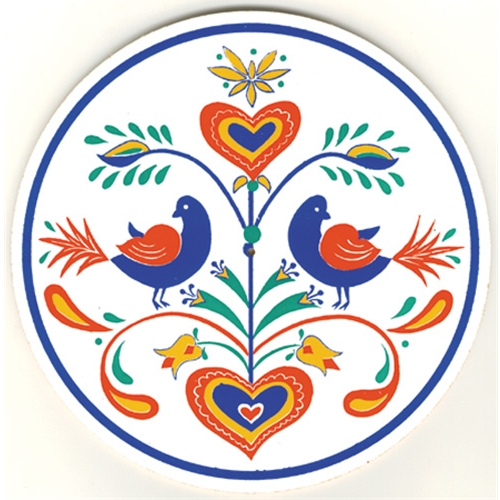
and traditions to Pennsylvania, the "fancy" farmers
decorated their distinctive bank barns with large,
colorful geometric patterns. Mystical bird and floral
designs graced birth and marriage certificates, family
bibles and some furniture. These very colorful symbols,
now called Hex Signs, had meanings or "legends". A
design was selected based on both its aesthetics and
meaning for the family.
Some of the more popular symbols
included, but not limited to: sun wheel for warmth and
fertility, hearts for love, birds (called Distlefink)
for good luck and happiness, tulips for faith and stars
for luck. The specific colors used also had meaning: red
for your emotions, yellow for love of man and the sun,
green for growing things, blue for protection, white for
purity, and brown for Mother Earth.
Early hex signs were
painstakingly hand painted directly on walls, doors,
books, etc. Jacob Zook, an 11th generation PA Dutchman,
had a boyhood fascination with hex symbols that
developed into a "Love Affair" as he grew older. On or
about 1942, he began experimenting with hand silk
screening of these symbols on round disks. Silk
screening would make hex signs available at a modest
cost for everyone's enjoyment. Hex Signs are still made
this way today. Most hex symbols are screened using four
paint colors. Each color is applied as a separate step
with about a day allowed for the paint to air dry before
applying the next color. It's only after the fourth or
final color is applied that the hex design becomes
recognizable.
Artists who design and hand paint Hex Signs are known
as "Hexologist", there are many silkscreen manufactures
producing silkscreen signs today, but only a few
Hexologist are practicing their art today and offer
their Hex Signs hand painted such as Ivan Hoyt. In my
online store
https://unclejacksdelights.com/hexspec.htm
and eBay, that it is my pleasure to offer both
Jacob Zook (Zook's Dutch Novelties) and
Ivan Hoyt (Conestoga) designed "silkscreened"
Hex Signs. My Hex Signs are now being enjoyed throughout
the world. Their color, beauty, originality and
affordability make them unusual delightful gifts for
family and friends.
Symbol Meanings
|
The Symbol |
Its Meaning |
|
Circle |
Eternity or Infinity |
|
Distelfink (Bird) |
Good Luck and Happiness |
|
Dove |
Peace and Contentment |
|
Eagle |
Good Health, Strength and Courage |
|
Four Pointed Star |
Bright Day |
|
Heart |
Love and Kindness |
|
Horse Head |
Protect Animals from Disease and Building from Lightning |
|
Maple Leaf |
Contentment |
|
Oak Leaf |
Strength |
|
Quarter Moons (4) |
Four Seasons of the Year |
|
Raindrops |
Abundance, Fertility, Rain |
|
Rosette |
Good Luck. Keep Away Bad Luck and Evil |
|
Star |
Good Luck |
|
Triple Star |
Success, Wealth and Happiness |
|
Tulip |
Faith |
|
Tulips (Trinity - 3) |
Faith, Hope and Charity |
|
Twelve Pointed Rosette |
A Joyous Month for Each Month of the Year |
|
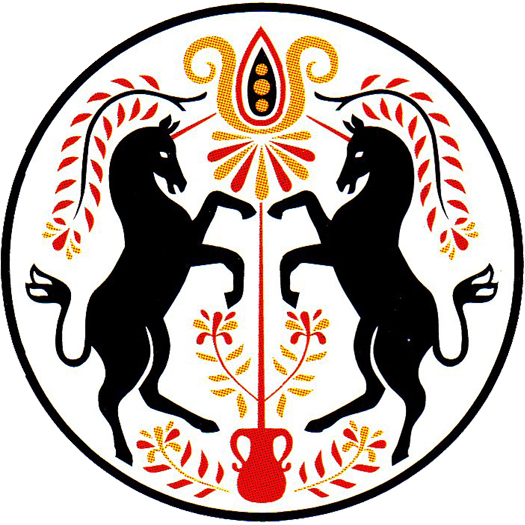
Unicorn |
Virtue and Piety. Belief in God |
|
Wavy Border |
Smooth Sailing Through Life |
Indoor Use / Outdoor Use
8" Size:
Put one small
rustproof screw or nail (Brass) in the
hole near the center of the Hex Sign.
16" size:
Put one small rustproof screw or nail (Brass)
in the hole near the center of the Hex Sign. Drill 3
small holes, equally spaced, near the outer edge. Fasten
with 3 rustproof screws or nails (Brass).
24" size:
Put one small rustproof
screw or nail (Brass) in the hole near the
center of the Hex Sign. Drill 4 small holes, equally
spaced, near the outer edge. Fasten with 4
rustproof screws or nails (Brass).
All signs must be mounted
on a flat surface
tightening the screws or nails on an uneven surface will
damage the sign.
For Outdoor
Use:
it is strongly suggested to seal the back and outside
edge of the Hex Sign with a
Clear Acrylic Coating.
If the sign will be placed facing direct sunlight it is
suggested to use a UV-Resistant Clear Acrylic Coating
to the front of the sign.
There may be a hole in the center and a notch located on
the outside edge that was used in the silk screen
process which can be used to hold down the outside edge.
Each sign is made individually using high quality paints
on the front of the sign but no coating on the back
therefore
the back
of the sign should never be exposed to the weather.
Each pattern and sign are unique in some way. Enjoy you
silk screen art! |

 ALL
PRODUCTS ARE
CREATED IN AMERICA
ALL
PRODUCTS ARE
CREATED IN AMERICA